A NEXUM product · In development
Orders are growing. Will there be enough cash for the next delivery?
With cash on delivery, a sale today does not mean money in the account today. Cash Runway is a product in development for forecasting receipts, payments and stock, taking delayed payouts and refused parcels into account.
The problem
A sale and a cash receipt are different events
The order is placed
The ad that brought it in is already paid for. In the store report it looks like a sale. Nothing has reached the bank account yet.
The parcel ships
You pay for packaging and the courier. The goods leave the warehouse, but they are neither sold nor returned yet. The outcome is unknown.
The customer collects it, or does not
The parcel reaches the pickup office and waits. Some are collected on the first day, some on the sixth, some are never claimed. Until the holding period runs out, you cannot tell which is which.
The courier pays out
The money reaches your account as a courier transfer, after the customer has paid and with fees withheld. An uncollected parcel brings no transfer, and the courier cost in both directions stays with you.
Meanwhile the deadlines keep running
Stock runs down and the supplier wants a deposit. The VAT payment has a date. So do salaries and rent. All of them are paid from the same account that the money from current orders has not reached yet.
Where the numbers break
Four places where the spreadsheet gets it wrong
Many merchants track this in a spreadsheet or in their head. The numbers tend to drift in the same places and most often in one direction: it looks like there is more cash than will actually arrive.
A refused parcel is not zero
It brings no revenue, but it costs money: the ad spend for the order, the courier in both directions and the packaging. There is no payout for it, so its fees are withheld from the money for other, delivered parcels. A calculation that counts fees only for delivered parcels shows more than will come in.
Shipped is not sold
Refused goods come back to the warehouse days or weeks later. If stock is calculated from units shipped, it looks like you run out sooner and you order more than you need. That leaves cash sitting in the warehouse that is missing from the account.
Stock is ordered before the cash arrives
The supplier lead time counts back from the day the stock runs out. If delivery takes 30 days, the order goes out 30 days earlier, whether or not the money from current parcels has been collected. For imports from outside the EU, customs duty and VAT go out on a separate date.
Part of the balance is not yours
The money in the account includes VAT you collected from customers and will pay by the 14th of the following month. If that money goes into stock in the meantime, it is not there on the payment date.
The solution
What changes with Cash Runway
The three questions are the same daily line seen from three sides: what to order and when, whether the cash will be enough, and how much VAT to set aside.
The lowest cash point, with a date
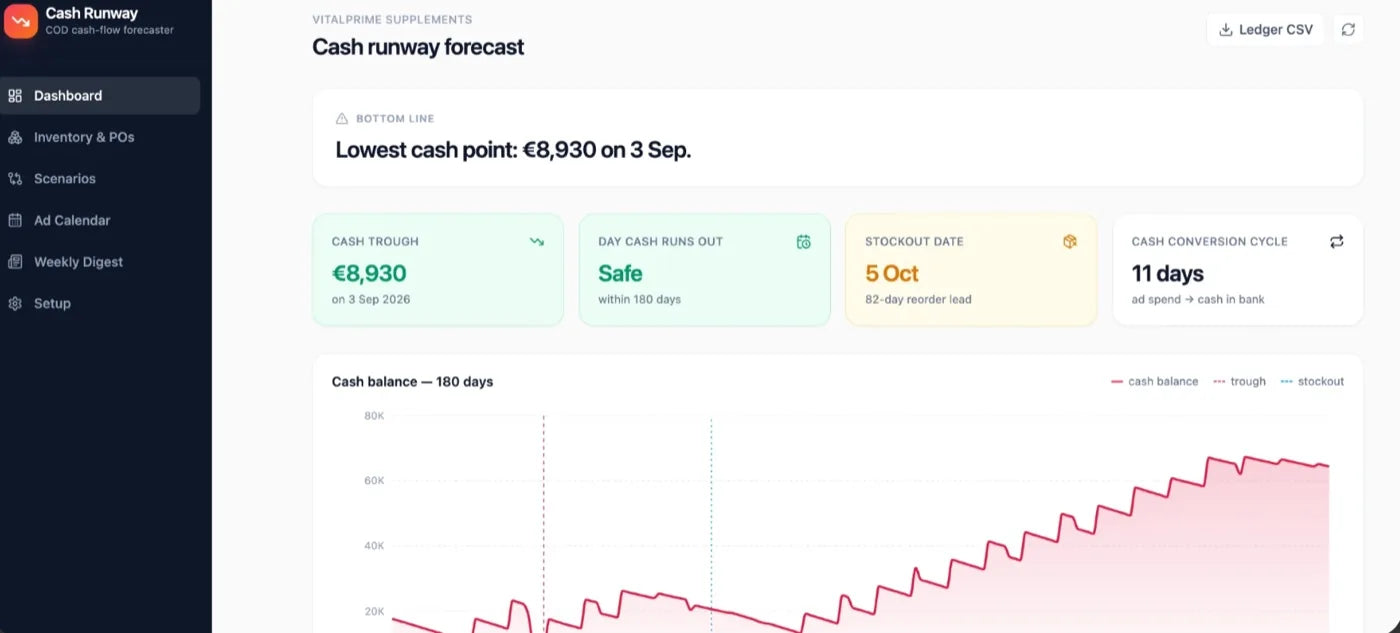
This is the dashboard from the working prototype, with demo data for a made-up store. The final interface may look different. At the top is one sentence: how low the cash goes and on which date.
- Cash trough: the lowest account balance in the forecast and its date.
- Day cash runs out: the day the money runs out, or Safe when there is no such day in the period.
- Stockout date: when the stock runs out, with the reorder lead time below it.
- Cash conversion cycle: how many days pass from ad spend to cash in the bank.
- A cash balance chart for 180 days ahead, with the lowest point and the stockout day marked.
- Menu: inventory and purchase orders, scenarios, ad calendar, weekly digest and setup.
What it shows
Your position today and what is coming
The home screen is not a dashboard of dozens of equally large metrics. At the top is one answer: will the cash last until the next stock order. Everything else explains it.
Where the money is
In the account; collected from customers but not yet paid out; waiting at pickup offices, with the expected loss from uncollected parcels; stock in the warehouse at cost; paid stock that is still in transit.
A cash curve with two lines
The solid line is the cash balance. The second is the balance without the VAT you still have to pay. Below the chart are only the days on which something goes out, and which item it is.
Supplier order
When the stock runs out, the date by which you need to order, the quantity given the minimum order and lot size, how much goes out at order and how much on arrival.
VAT payment
The expected amount for the period and its date. Under Bulgarian rules the deadline is the 14th of the following month and moves to the next working day when it falls on a non-working day.
Delivery rate
Measured from your own parcels, not typed in. Orders that never shipped and parcels that were not collected are counted separately, because they cost different amounts and show up with a different delay.
Real cost per order
The ad platform reports cost per order placed. You pay for delivered ones. Ad spend is divided by delivered parcels and compared with the orders found in the store.
Notifications. They are sent only in the four cases where someone has to act today: the supplier order date is due, a cash shortfall is expected, a VAT payment is coming up, or a courier payout does not match what was expected. The channels are email and Telegram.
How it works
How the forecast is built
One day is one row. Every event goes in with its exact date and its source, not as a monthly average.
History from the store
Once the store is connected, the history is pulled in: orders, products, stock, fulfilments and statuses. It shows which payment methods are cash on delivery and which couriers you use. You confirm them once.
Pickup curve
From closed parcels, the app measures what share is collected on day one, day two and so on, and what share is never claimed. A parcel that has already waited four days has a different expectation from one that has just arrived. Below 100 closed parcels the curve is not treated as measured, and the screen says so.
Courier payouts
The courier statement shows when the money actually arrived and how much was withheld. Rows are matched to parcels by tracking number, not by amount and date. A difference in amount, an unknown parcel or a fee outside the tariff is shown, not skipped.
Commitments by date
VAT, suppliers, courier, fulfilment centre, ads, salaries and other costs go in with their dates. Each is marked as fixed or as something that can be paused, so you can see how much cash a decision frees up.
Stock including returns
Refused goods are expected back after the return transit time, less the scrap share. They count as available only after inspection in the warehouse. A lost parcel does not go back into stock. Example: out of 100 units shipped with 72 collected, 72 have actually left the warehouse, not 100.
VAT on what was actually received
In the model, for cash on delivery the period is set by the day the money reaches the account. The tax is taken out of the collected amount, which includes VAT. A refused parcel carries no VAT. Ads invoiced from abroad and goods from an EU supplier do not reduce the payment.
Checking both days
For each supplier order, the app checks whether the cash is enough on the order date and again on the arrival date, when duty and VAT are paid for imports from outside the EU. It can be enough on the first and not on the second.
Data
What data it needs
The first step is connecting the store. The rest is added step by step and makes the forecast more complete. Each step says what does not work until it is done.
From Shopify
Orders, products, stock and fulfilments, together with the history. You confirm which payment methods are cash on delivery and which couriers are yours.
For the courier
The tariff from your contract, the holding period at the pickup office and the cash-on-delivery statements as a file. The file columns are mapped once and remembered. Uploading the same statement twice does not double anything.
For the warehouse
Whether you ship yourself or through a fulfilment centre, and who pays out your cash-on-delivery money. With a fulfilment centre you upload the contract with its tariff; the recognised figures are a suggestion that you confirm.
For suppliers
Lead time, minimum order, lot size, unit cost and where the goods come from: Bulgaria, the EU or outside the EU. Without an origin the order calculation does not start.
For VAT
Whether you are registered and at what rate, and the costs with Bulgarian VAT that reduce the payment.
For cash and costs
How much is in the account today and your fixed costs: rent, salaries, software. The balance is the one number that cannot be read from anywhere.
Scenarios
What happens if you move one date
A scenario is a change on top of the same inputs, not a separate calculation. The forecast runs once with the current numbers and again with the change, and the two results are compared: the lowest cash point and its date, the stockout day and the balance at the end of the period.
- The supplier order moves by a few days so it does not land on the VAT payment.
- Ads for one product are reduced or paused until the new stock arrives.
- The delivery rate changes by a few points.
In the prototype, scenarios are a separate screen. In the new version this part has not been built yet.
Who it is for
When it fits and when it does not
Not a fit if
- Accounting: you are looking for bookkeeping and filing software. Cash Runway produces a forecast and files nothing with the tax authority.
- Few parcels: below 100 closed parcels the pickup curve cannot be measured.
- Several currencies: the VAT part does not convert currencies and refuses such a period instead of guessing.
- Own manufacturing: raw materials, work in progress and finished goods on several levels are not modelled.
- Another platform: we are currently working only on the Shopify connection.
A fit if
- Cash on delivery: a large share of your orders is paid to the courier.
- Long lead time: you order stock weeks before the money from current sales has arrived.
- VAT: you are registered and the monthly payment is an item you have to plan for.
- Warehouse: you ship yourself or through a fulfilment centre. Both are covered, with different fees.
- A spreadsheet that no longer copes: you track courier payouts, stock and deadlines by hand.
Current stage
The product is in development. We are working on Shopify connectivity, forecasting and notifications. It is not currently offered as an immediately available public installation.
The screen on this page comes from a prototype with demo data. Scenarios and the weekly digest are not ready in the new version yet.
Forecasts depend on the data and assumptions provided. They support planning and do not replace accounting review. The VAT figure is a guide to how much to set aside, not a tax return. Your accountant decides for your case.
Questions
Frequently asked questions
Can I install Cash Runway now?
No. The product is in development and is not a publicly released app. If you leave your email in the form below, we will write to you about access and the next steps.
Does it replace my accountant?
No. Cash Runway shows the expected VAT payment and its date so you can set the money aside in time. It does not do bookkeeping or file returns. The rules in the model have been reviewed with an accountant, but the forecast does not replace accounting review for your company.
How does it know when the courier money will arrive?
From your own history. From closed parcels it measures after how many days they are collected and what share is never collected. Courier statements show when the money actually arrived and are matched to parcels by tracking number. This is a forecast based on measured data, not a guarantee of a specific payout.
How is VAT calculated for cash on delivery?
In the model, which follows Bulgarian rules, the period is set by the day the money reaches the account, and the tax is taken out of the amount actually collected, which includes VAT. The fee withheld by the courier does not reduce the base. A refused parcel carries no VAT. The payment deadline is the 14th of the following month.
Does advertising reduce the VAT payment?
Advertising invoiced by a supplier outside Bulgaria is under reverse charge: the tax is charged and deducted at the same time, so the net effect on the payment is zero. The same applies to goods from an EU supplier. The payment is reduced by invoices with Bulgarian VAT charged and by VAT paid on import. Customs duty is not recoverable.
Do I have to connect my courier?
You start by connecting the store. Cash-on-delivery statements are uploaded as a file, and the tariff is entered from your contract. We do not promise a direct connection to any specific courier at this stage.
What happens when data is missing?
The calculation stops and says what is missing. An empty tariff item is not treated as zero, and a missing origin of goods is not replaced with an assumption. When two sources give a different count for the same thing, the decision is left to a person.
Does it work with WooCommerce?
We are currently working on the Shopify connection. We do not promise support for another platform.
Follow its progress
Leave your email for updates about access and the next product stages.
This subscription is only for Cash Runway. You can unsubscribe from future messages.
In development